The Best Picture Mission: 83 films, 166 days, a step into the greatest films of all time.

DEADLINE: August 24, 2010.


Monday, March 22, 2010

Film #7: LOTR: The Return of the King


Movie #7: The Lord of the Rings: The Return of the King (2003)
Oscar wins: 11- Best Picture, Best Director (Jackson), Best Adapted Screenplay (Walsh, Boyens & Jackson), Best Original Score (Howard Shore), Best Original Song, Best Visual Effects, Best Art Direction, Best Costume Design, Best Make-Up, Best Sound Mixing, Best Film Editing
Nominations: None
Directed by: Peter Jackson
Written by: Fran Walsh, Philippa Boyens & Peter Jackson based on the novel by J.R.R. Tolkien
Starring: Elijah Wood, Sean Astin, Ian McKellen, Viggo Mortensen, John Rhys-Davies, Orlando Bloom
Length: 200 minutes
Budget: $94 million


The greatest fantasy film of all time (and the only one to win Best Picture), and the conclusion to one of the best film triliogies of all time, The Lord of the Rings: The Return of the King dominated the 76th Academy Awards, winning all eleven of the films for which it was nomianted.

The Return of the King is the conclusion of the Lord of the Rings trilogy, and it tells the tale of the hobbit Frodo Baggins (Wood) and his quest to destroy the One Ring in Mount Doom. He is followed by Gollum, and hunted by dark forces, while the rest of his now-broken-up fellowship battles the soldiers and creatures of the enemy.

This film, at a whopping three hours and twenty minutes, is the longest winner so far, by about 50 minutes. Also, with a budget of $94,000,000, it passes The Departed by four million dollars to be the most expensive. From the technological marvels, to the awe-inspiring visuals, to the incredible adaption of Tolkien's novel, Peter Jackson put together one of the biggest films in Hollywood history.

Many people have said that the awards The Return of the King won at the Oscars were really for the entire trilogy, but I'm entirely fine with this. The people involved with this trilogy took on a humongous project, and could not have done it any more successfully. Perhaps its only "weak" point was the acting, and this was reflected in its lack of any acting nomination throughout the three years it received nominations. Don't be fooled, though, the acting in this film is still very strong, all of the actors hold their own and are above average, but the acting is really split among several different characters, and all of their performances lack extreme difficulty. That being said, all of the actors should still be praised for bringing to life so successfully Tolkien's characters-- for fantasy fans everywhere.

If you've never seen the Lord of the Rings films, you are really missing out. Even if you aren't a fantasy fan, or don't enjoy the usual adventure film, these movies surpass every expectation to reach out to every viewer, and you might be surprised when you become fascinated with them.

As for my rankings, I've run into my first incredibly tough choice. As a whole, I think the trilogy would rank among my favorite films of all time. However, when rating this one installment against the other films I have seen, it's very tough to put it as #1, simply because I fell so in love with Million Dollar Baby the first time I saw it. I think LOTR definitely ranks above The Hurt Locker and the two below it, but it's a really tough choice among The Departed and No Country for Old Men. In the end, though, I think its entertainment value and the incredible work that Jackson did in this film has to put it up at #2.

Rankings:
1. Million Dollar Baby (2004)
2. The Lord of the Rings: The Return of the King (2003)
3. The Departed (2006)
4. No Country for Old Men (2007)
5. The Hurt Locker (2009)
6. Crash (2005)
7. Slumdog Millionaire (2008)

Sunday, March 21, 2010

Million Dollar Baby (2004)


Movie #6: Million Dollar Baby (2004)
Oscar wins: 4- Best Picture, Best Director (Eastwood), Best Actress in a Leading Role (Swank), Best Actor in a Supporting Role (Freeman)
Nominations: Best Actor in a Leading Role (Eastwood), Best Adapted Screenplay (Haggis), Best Editing
Directed by: Clint Eastwood
Written by: Paul Haggis based short stories by F.X. Toole
Starring: Clint Eastwood, Hilary Swank, Morgan Freeman
Length: 132 minutes
Budget: $30 million

My sixth film-- and my favorite so far-- is Million Dollar Baby, a film directed by my favorite director (Clint Eastwood), and starring my favorite actress (Hilary Swank). Both do amazing work in this touching tale about a female boxer. Also, it was Paul Haggis's first Academy Award nomination of three (he would go on to do Crash, last post's winner!, and also another one of my favorites by Eastwood, Letters from Iwo Jima).

Maggie Fitzgerald (Swank) is an aspiring female boxer, who goes to the local gym of Frankie Dunn (Eastwood) and convinces him to train her. Dunn, meanwhile, struggles with his own problems, and an incredible bond develops between these two, despite his original feelings. Throw in ex-fighter and gym worker "Scrap" (Freeman), and you get an excellent mix of sports, drama, and even the occasional humor.

Whenever I try to get anyone to watch this film, their response is always the same: why would I want to watch a movie about boxing? What they don't realize, though, is that boxing is only the backdrop for this film, and the real story lies within the characters and their relationships. Eastwood does an incredible job shooting this film and sets an amazing scene, and then all of the actors hold their own and pull it together. It is, for sure, one of my favorite movies of all time.

At the 77th Academy Awards, the film with the most nominations was The Aviator (with 11), and Million Dollar Baby came in with (only?) 7. The Aviator also won the most awards, with 5. It is an excellent film, about the life of Howard Hughes, and it is amazing on a technical level-- editing, cinematography, and the acting of Cate Blanchett and Leonardo DiCaprio is REMARKABLE.

These Oscars featured three (Swank, Blanchett, and DiCaprio) of my favorite performances of all time, and even though Jamie Foxx (in Ray) wasn't my favorite, it was still a terrific piece of acting. This was also the first year I really got into watching the Oscars, and I have been a huge fan ever since.

So, another film is down. Next is The Lord of the Rings: The Return of the King, and their amazing double digit sweep at the 76th Awards.

Rankings:
1. Million Dollar Baby (2004)
2. The Departed (2006)
3. No Country for Old Men (2007)
4. The Hurt Locker (2009)
5. Crash (2005)
6. Slumdog Millionaire (2008)

Friday, March 19, 2010

Crash (2005)


Image: http://upload.wikimedia.org/wikipedia/en/thumb/d/d0/Crash_ver2.jpg/200px-Crash_ver2.jpg

Movie #5: Crash (2005)
Oscar wins: 3- Best Picture, Best Original Screenplay (Haggis & Moresco), Best Film Editing
Nominations: Best Director (Haggis), Best Supporting Actor (Dillon), Best Original Song ("In the Deep")
Directed by: Paul Haggis
Written by: Paul Haggis & Robert Moresco
Starring: Brendan Fraser, Sandra Bullock, Chris "Ludacris" Bridges, Larenz Tate, Don Cheadle, Jennifer Esposito, Ryan Philippe, Matt Dillon
Length: 112 minutes
Budget: $6.5 million

From low budget to big cinema and back again, Crash has the smallest budget of the five films I've watched, at (a measly?) six and a half million dollars. And, I must say, it is the first winner that I strongly disagree with.

Crash is a gritty, raw tale of hardship and racism in Los Angeles, that follows the lives of many people: policemen, store owners, Chinese immigrants, African Americans in the business world and those on the streets, Iranians, and everything in between. The film reveals the realities behind ignorance, racism, and the problems they cause, and how lives can intersect and affect one another in remarkable ways.

This is a very good film. Like The Departed, it features a load of stars that just pop-up out of nowhere, and give very strong performances. Oscar winner Sandra Bullock (ha ha) plays an ignorant, lonely woman, Matt Dillon plays a dirty (pun intended) cop, Ryan Philippe plays his kind partner who struggles to get out from under his control, Ludacris and Larenz Tate play car jackers, Bahar Soomekh plays a young Iranian American whose father (Shaun Toub) struggles to cope in America, and the cast list goes on and on. Also, Haggis and Moresco wrote an incredible screenplay to bring all of these characters in and deliver such an emotional and powerful message. So, my problem? Brokeback Mountain was an incredible piece of filmmaking, and was better than Crash on every aspect.

I won't go into the Brokeback Mountain vs. Crash debate, because it's all been said before. No matter how many times I see either film (which is around five for both, right now), I will never change my mind on the fact that Brokeback Mountain was the best film of 2005. Thankfully, Ang Lee at least won Best Director, which he completely deserved for his masterpiece.

The 78th Academy Awards spread its prizes among a lot of films, with the most only winning three. Brokeback Mountain won director, score, and adapted screenplay, while Memoirs of a Geisha walked away with three art awards and King Kong walked away with the sound and special effects awards. Then, of course, Crash won its three awards.

Perhaps surprisingly, Crash does not go at the bottom of my list. I would not have given the Best Picture award to this film or Slumdog Millionaire, but for two different reasons: Slumdog Millionaire I didn't think was a good enough film to earn that crown, while Crash was good enough, but given its year and the fact that it went against Brokeback Mountain, it didn't deserve it.


Rankings:
1. The Departed (2006)
2. No Country for Old Men (2007)
3. The Hurt Locker (2009)
4. Crash (2005)
5. Slumdog Millionaire (2008)

Wednesday, March 17, 2010

Film #4: The Departed (2006)


Image: http://upload.wikimedia.org/wikipedia/en/thumb/5/50/Departed234.jpg/200px-Departed234.jpg

Movie #4: The Departed (2006)
Oscar wins: 4- Best Picture, Best Director (Scorsese), Best Adapted Screenplay (Monahan), Best Film Editing
Nominations: Best Supporting Actor (Wahlberg)
Directed by: Martin Scorsese
Written by: William Monahan from the film Infernal Affairs by Felix Chong and Alan Mak
Starring: Leonardo DiCaprio, Matt Damon, Jack Nicholson, Mark Wahlberg
Length: 151 minutes
Budget: $90 million

The Departed, based on the 2002 film from Hong Kong, Infernal Affairs, is a crime drama about two moles, one in the state police and one in the mob, and their struggle to stay hidden, find each other, and above all: stay alive.

Billy Costigan (DiCaprio) enters the Academy and wants to work for the police, but is instead forced to go undercover as a police mole in the mob. Meanwhile, mob boss Frank Costello (Nicholson) has trained Colin Sullivan (Damon) to infiltrate the same police force as a mole. The Departed shows the gritty, face-paced life of South Boston crime-- both from the police stand point, and that of organized crime.

Scorsese goes out on a limb with this film by remaking a movie only four years old, and taking the setting from Hong Kong right into the streets of Boston. What he created, though, was a huge success. The Departed is a film that makes the viewer think, and takes them on a ride where they begin to question-- who is the hero? who are the villains? and what other stars are going to pop up in this film?? From the leads of DiCaprio and Nicholson, to the new age femme fatale Vera Farmiga, to even Alec Baldwin. It's a very Hollywood, big-budget film, on the complete opposite end of the spectrum from small, Bollywood Slumdog Millionaire.

Another interesting aspect of The Departed is how it brings crime into the 21st century, taking the old noir and crime films and putting a new age twist on them. It talks about fate, chance, and how lives can become so intertwined in a world of death and virtual war. This movie also shows the new age American dream, with DiCaprio struggling to ovecome his name and family history to get somewhere in life, and Damon using his past to get ahead in the world (in anyway he possibly can) and make money. It calls loyalty into question, and shows lies and deception and their use in the world. And, throughout it all, Scorsese keeps the film in check, keeping it on track and preventing it from going over-the-top.

For as incredible of a film as The Departed was, it may be somewhat surprising that it only came away with four Oscars (and only five noiminations!). However, when considered, it doesn't seem like such a surprise. It won the other three awards that Best Picture winners typically receive: director, screenplay, and editing. Other than those awards, though, there was not much else The Departed had: very little in the way of a musical score (like most Scorsese films), great actors but all with small parts, only one real female (which, again, was a small part from Farmiga), and nothing toward cinematography, effects, or sound (all of which it did not need). As a result, The Departed won everything it deserved, and was even given a supporting acting nomination for Wahlberg (which I would argue should have gone to Nicholson, DiCaprio, or Damon, but I'm not sure who was considered as "lead." Also, DiCaprio got a best actor nomination for his other film, Blood Diamond).

Also, at the 64th Golden Globe Awards, the film actually lost Best Drama Film to Alejandro González Iñárritu's Babel (which, incredibly enough, only won that one award, losing three supporting acting awards, director, score, and screenplay). The Departed got one award, Scorsese for best director, but it's acting awards were a little more how I would have liked: DiCaprio getting a lead nomination (for Blood Diamond as well!), and Nicholson and Wahlberg getting nominations in the supporting category.

So, my fourth film is done, and it was an amazing film at that. The Departed is really a Hollywood film, that appeals to the main stream public and is an incredible piece of filmmaking. It's a tough call between it and No Country, but I think The Departed just edges it out in my book (maybe it's just because I'm a Scorsese fanatic...)

Rankings:
1. The Departed (2006)
2. No Country for Old Men (2007)
3. The Hurt Locker (2009)
4. Slumdog Millionaire (2008)

Monday, March 15, 2010

Best Picture #3


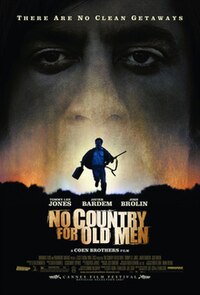
Image: http://upload.wikimedia.org/wikipedia/en/8/8b/No_Country_for_Old_Men_poster.jpg

Movie #3: No Country for Old Men (2007)
Oscar wins: 4- Best Picture, Best Director (Coens), Best Supporting Actor (Bardem), Best Adapted Screenplay (Coens)
Nominations: Best Sound Editing, Best Sound Mixing, Best Cinematography, Best Film Editing
Directed by: Joel & Ethan Coen
Written by: Joel & Ethan Coen from the book No Country for Old Men by Cormac McCarthy
Starring: Josh Brolin, Javier Bardem, Tommy Lee Jones
Length: 122 minutes
Budget: $25 million

No Country for Old Men, the most expensive film so far (by $10 million) is a remarkable adaptation of the Cormac McCarthy novel. As a huge fan of McCarthy and reader of all of his books, it comes with great praise that I say: this is one of the few incidences where the film was better than the book. Joel and Ethan Coen created an amazing screenplay, and pulled out all their tricks to not only follow closely with the book, but expand on it.

This is a film about Llewelyn Moss (Brolin), who finds money out in the desert at the scene of a drug deal gone wrong. Moss decides to take the money, and what ensues is a ruthless hunt. Anton Chigurh (Bardem) is a brutal, heartless hitman who tracks Moss, and Ed Tom Bell (Jones) is a sheriff also on their tail, not to take Moss in, but rather to protect him from the brutality that he knows exists in Chigurh (pronounced shi-gehr, not "sugar").

This is definitely my favorite film of the three I have watched so far. Javier Bardem gives one of the best acting performances I have ever seen, creating a chilling character who fits perfectly with the depiction in the novel, while the Coen brothers give this their typical unexpected comedic-twist. There are also strong performaces all around, from Brolin and Jones and even Woody Harrelson, who makes his appearance as yet another person hunting Moss and the money.

Ironically enough, at the 80th Academy Awards, three of the films four losses came at the hands of an action film, The Bourne Ultimatum. The fourth came (rightfully) to There Will Be Blood in Best Cinematography. That ceremony was one with very spread-out awards and recognition, with the leaders (No Country and Blood) at eight nominations, two more films at seven, and then 17 films with between 2-5 nominations. No Country led the winners with a very low four wins. This was a very strong year in film, with great acting performances like Daniel Day-Lewis (Blood) and (probably) my favorite performance of all time, Marion Cotillard in La Vie en Rose coming through in a (somewhat) surprise. Also, shockingly enough, a comedy film was nominated for Best Picture that year, with Juno getting four nominations, winning Best Original Screenplay for Diablo Cody.

Next, I move on to The Departed, which won the award for Best Picture in 2006.

Rankings:
1. No Country for Old Men (2007)
2. The Hurt Locker (2009)
3. Slumdog Millionaire (2008)

Saturday, March 13, 2010

Jai Ho!


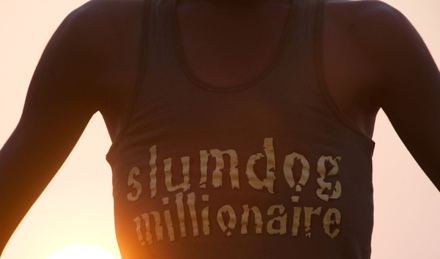
Image: http://www.slashfilm.com/wp/wp-content/images/slumdogmillionairetrailertop.jpg


Movie #2: Slumdog Millionaire (2008)
Oscar wins: 8- Best Picture, Best Director (Boyle), Best Adapted Screenplay (Beaufoy), Best Original Score (A.R. Rahman), Best Original Song ("Jai Ho"), Best Sound Mixing,  Best Cinematography, Best Film Editing
Nominations: Best Song ("O Saya"), Best Sound Editing
Directed by: Danny Boyle
Written by: Simon Beaufoy from the book Q & A by Vikas Swarup
Starring: Dev Patel, Freida Pinto, Madhur Mittal
Length: 121 minutes
Budget: $15.1 million

I still cannot believe that this film won the hearts of so many viewers and the Academy. I use to complain about this fact, but when I watched the film this time around I truly enjoyed it. My main complaint remains, though: it's so hokey! It's a very cheery, upbeat, colorful film with touching sentimentality and many "awww how cute!" moments. Not that there is anything wrong with that, it's just not the typical Best Picture film of recent years.
 
Slumdog Millionaire tells the story of Jamal (Patel), a chai wallah ("tea server," which I had to look up!) from the slums of Mumbai, India who goes on the Indian version of Who Wants to Be a Millionaire and, after making it to the final question, is accused of cheating and arrest. What follows is an interrogation where Jamal, essentially, tells the story of his life, and that of his brother Salim (Mittal) and the love of his life, Latika (Pinto), in an attempt to explain how he knew all of the answers.
 
Just like The Hurt Locker, Slumdog Millionaire is a technical masterpiece. The camera work and techniques that Boyle puts to work here are amazing, and he creates a beautiful film. The writing, although, as I said, hokey at times, is very well done and a terrific script is constructed for the film. As for the acting, Patel, Mittal, and Pinto give solid performances as the present-day "three musketeers," but the best performances come from the children. Ayush Mahesh Khedekar (as Jamal) and Azharuddin Mohammed Ismail (as Salim) give REMARKABLE performances through the first half of the film, and they are surrounded by great work from other youngsters as well. This film also won the Screen Actors Guild Award for Best Ensemble, simply because of these children.
 
Slumdog Millionaire really only lost one Oscar, and that was to The Dark Knight for Best Sound Editing (its only other lose came to itself in Best Original Song). I think the film benefited from a very weak year in cinema, and presented a technically sound and entertaining film (as "hokey" as it may be) alternative to the typical Hollywood films that were being shown in 2008. I'm not saying that Slumdog wasn't a good film, it was very good; but I am saying that it isn't the typical Academy-loving (or even critic-loving) film, and it still shocks me that they rewarded at so kindly during awards season.
 
All-in-all, my third viewing of Slumdog Millionaire was very beneficial. By now, I'm over the fact that Revolutionary Road (my favorite film of 2008!) was snubbed, and also that The Curious Case of Benjamin Button was so poorly received. I was able to take a fresh look at the film, and really see the good qualities of it. Of course, I would recommend this film, but I still prefered The Hurt Locker...
 
Rankings:
1. The Hurt Locker (2009)
2. Slumdog Millionaire (2008)

Thursday, March 11, 2010

Day #1, Movie #1: The Hurt Locker (2009)


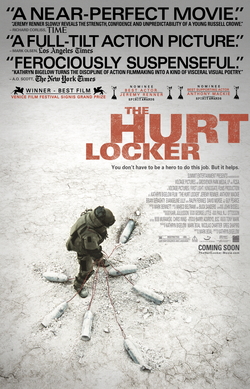
Movie #1: The Hurt Locker (2009)
Oscar wins: 6- Best Picture, Best Director (Bigelow), Best Original Screenplay (Boal), Best Sound Editing, Best Sound Mixing, Best Film Editing
Nominations: Best Actor (Renner), Best Original Score, Best Cinematography
Directed by: Kathryn Bigelow
Written by: Mark Boal
Starring: Jeremy Renner, Anthony Mackie, Brian Geraghty
Length: 131 minutes
Budget: $11 million

This film, by the very talented Kathryn Bigelow, was crowned Best Picture at the 82nd Academy Awards just this past Sunday. It tells the (fictional) story of Sergeant First Class William James, and his experience leading a US Army EOD team (Explosive Ordnance Disposal). Basically, he is an expert at difussing bombs, and the film follows his experience leading his team in the US Army.

Right from the opening line by Chris Hedges ("The rush of battle is often a potent and lethal addiction, for war is a drug") and the opening scene (where we see James's future team trying to defuse a bomb), the film's point is clear: war is explosive (pardon the pun), war is tense, and for Sgt James, war is addicting.

In a controversial time in America, where people argue over who should be in Iraq, why we're there, how many people should be sent, how many should be taken out... Mark Boal presents a completely different point of view: some soldiers want to be over there, and the only time they feel right is when their adrenaline is pumping in the middle of the fight. Is he saying that troops should be kept there and allowed to go fight because they want to? Or, perhaps that war isn't all terror, destruction and devastation, but also has a "good" side (in providing a life and a purpose to many people)?

This was my third time watching the film, and the more I watch it the more impressed I am with Bigelow's work; from the camera angles, to the effects, and above all else, the tense and intense atmosphere she creates and holds throughout the film. I have heard some people (non-critics, mostly) say that the film gets rather boring. The more I watch the film, the more I can understand this. The film moves at a slow pace, from bomb to bomb, and can get slow in between, but each bomb is filled with an intense, dramatic atmosphere that leaves you waiting for something to explode.

I was amazed the first time I read that this film premiered at the Venice Film Festival, and that companies were unwilling to pay to distribute it in US theaters (presumably because of the failure of past Iraq War films), until Summit Entertainment purchased the rights. Even more impressive: the film received (reportedly) a ten minute standing ovation after it finished in Venice! To go from little film festival to little film festival, and eventually find your way to the title of Best Motion Picture of the Year is truly remarkable.

Overall, I would say that this film is unmatched (this year, at least) in it's technical features. A very good screenplay that creates the right tension at the right times; superb acting from a lesser-known cast; incredible cuts and editing, fused with the incredible sounds; and above all else, amazing directorial work from Bigelow, with a low budget and (almost) on-site filming in the Middle East. As for it's entertainment value, I admit that if you aren't impressed by the technical features, you might find it a little slow, and you problably won't want to watch it three times like me (in one month, I might add), but it's certainly entertaining and worth the just over two hours.

Lastly, I wanted to comment on the Avatar vs. The Hurt Locker race at the Oscars. Although I believe Avatar (which I have seen) is a technological (CGI, green screens, etc) marvel, I do not feel that it was the best film of the year. Yes, I certainly think it has an argument: it was extremely entertaining, was ground-breaking in its technological features, and was revolutionary in its success. However, it also had some problems: a weak screenplay, weak supporting performances, and the fact that a lot of it wasn't "real" acting or "real" events, but computer generated. Avatar deserves some sort of recognition for it's revolutionary and amazing effects, but it just wasn't all-around good enough to be "Best Picture of the Year." Unlike past "effects" winners (The Lord of the Rings and Star Wars, for example) of the Best Picture award, this one just lost too much ground to The Hurt Locker in all of the other elements of film.

One movie down, 82 more to go, 165 days.

Rankings:
1. The Hurt Locker (2009)